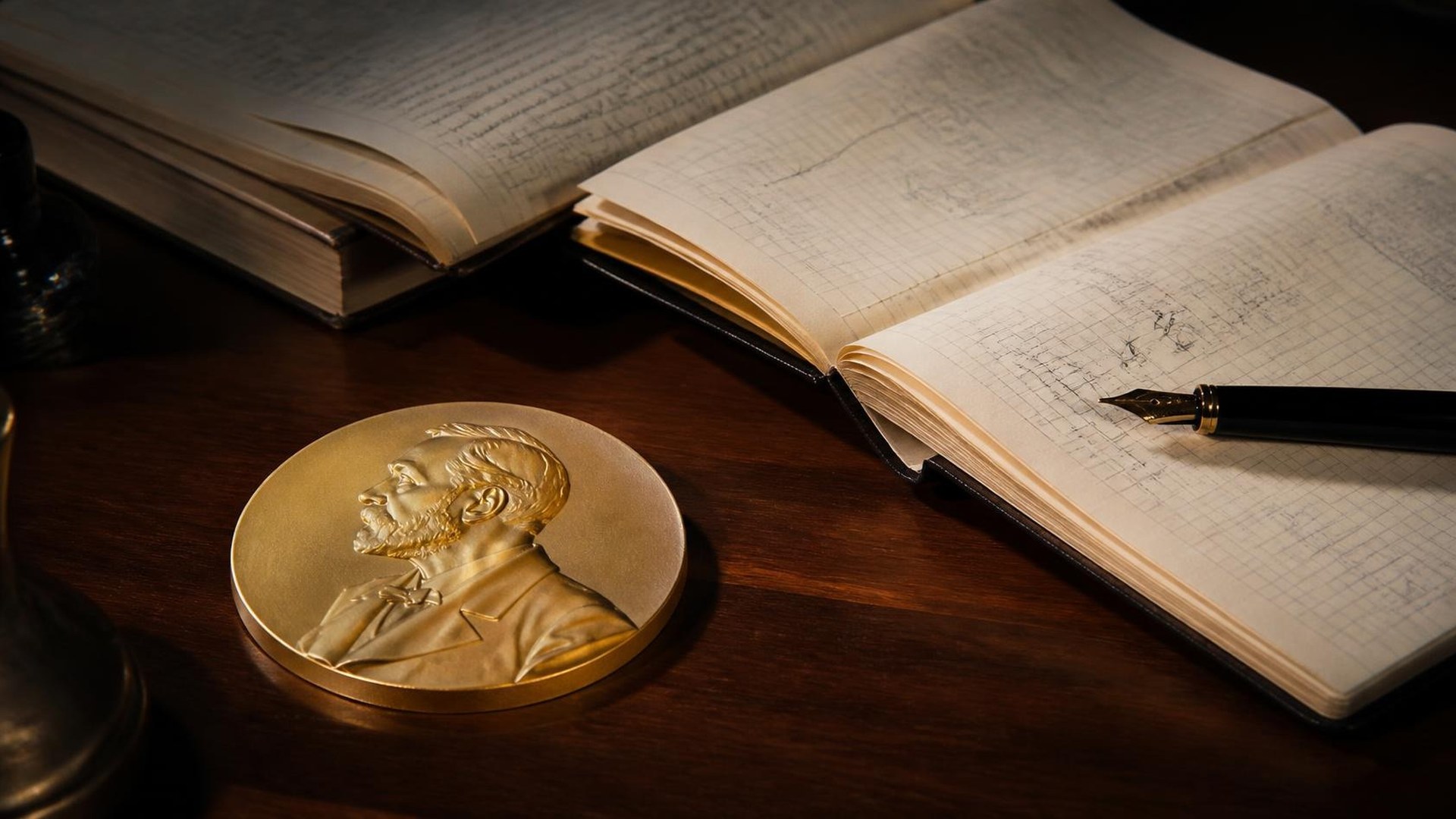
The 2026 Nobel season moved past medicine and physics this week. On October 7 the Royal Swedish Academy of Sciences announced the Chemistry Prize, and on October 8 the Swedish Academy named the Literature laureate. Together with the earlier awards, the week now has four of the six Nobel prizes decided, with Peace due on October 9 and the Sveriges Riksbank Prize in Economic Sciences scheduled for October 12.
This article covers only Chemistry and Literature, using the official press releases from NobelPrize.org. It does not repeat the Medicine or Physics write-ups already published elsewhere on World Gossip.
Chemistry 2026: Henri B. Kagan and Kenso Soai
The Royal Swedish Academy of Sciences awarded the Nobel Prize in Chemistry 2026 jointly to Henri B. Kagan of Université Paris-Sud in France and Kenso Soai of Tokyo University of Science in Japan. The citation is “for the discovery of non-linear effects and autocatalysis in asymmetric organic synthesis.”
The prize money is 12 million Swedish kronor, shared equally. The Academy frames the work as a solution to a long-standing puzzle: how chemistry can produce only one of two mirror-image forms of a molecule, a property called homochirality that living systems already show in amino acids and proteins.
Why mirror-image molecules matter
Many molecules exist as two variants that are mirror images of each other, like left and right hands. Living organisms generally use only one of those forms. When chemists run reactions that can make both mirrors, they often get a 50-50 mix. Drug development is one place that mix fails: only one mirror image may bind the intended biological target, while the other may be useless or harmful.
Heiner Linke, chair of the Nobel Committee for Chemistry, said Kagan and Soai “have provided a solution to a chemical mystery that is over a century old: how homochirality can emerge spontaneously,” and called the reactions they developed “spectacular.”
What each laureate contributed
According to the official press release:
Henri Kagan took a decisive step in 1986 by finding a new way to manipulate reactions so one mirror image could appear in a greater excess than chemists had thought possible. The Academy describes this as the discovery of non-linear effects in asymmetric synthesis.
Kenso Soai took the next step. A 1995 paper described the first reaction with the potential to become fully homochiral. In 2003 he reported a reaction in which only one of the two possible mirror images formed. The Academy says that, other than life itself, no one had previously achieved that feat.
The Academy concludes that the discoveries have been decisive for chemists who design reactions used in pharmaceutical manufacturing.
Who the Chemistry laureates are
Laureate | Born | Affiliation noted by Academy |
|---|---|---|
Henri B. Kagan | 1930, Boulogne-Billancourt, France | PhD 1960, Collège de France; Professor Emeritus, Université Paris-Sud |
Kenso Soai | 1950, Hiroshima, Japan | PhD 1979, University of Tokyo; Professor Emeritus, Tokyo University of Science |
Literature 2026: Anne Carson
On October 8, 2026, the Permanent Secretary of the Swedish Academy announced that the Nobel Prize in Literature for 2026 is awarded to Canadian author Anne Carson “for her bold and inventive oeuvre that, in playful dialogue with the classical tradition, has created new forms for contemporary literature.”
The official release is short compared with the science prizes. It identifies Carson as Canadian and centers the citation on form: work that talks with classical tradition while inventing new shapes for contemporary writing. Readers looking for a long biographical essay will need the Academy's later materials; the press release itself is the citation and the name.
Where the 2026 Nobel calendar stands
NobelPrize.org's announcement schedule for early October 2026 runs across several days. By the morning of October 9, the following pattern is clear from the official site:
Medicine and Physics were announced earlier in the week and are already covered in a separate World Gossip post.
Chemistry was announced October 7: Kagan and Soai.
Literature was announced October 8: Anne Carson.
The Nobel Peace Prize is scheduled for announcement on October 9.
The prize in Economic Sciences is listed for October 12.
Each science prize has its own live stream and PDF press materials on NobelPrize.org. Chemistry also published free-to-use illustrations by Johan Jarnestad for non-commercial use, explaining chirality, asymmetric reactions, Kagan's finding and the Soai reaction.
What the Chemistry prize means outside the lab
Homochirality is not only a theory problem. Modern drug chemistry needs reliable ways to make one mirror image of a molecule at industrial scale. The Academy's own summary places Kagan and Soai's work in that practical line: once chemists understand how a reaction can tip toward a single mirror form, they can design manufacturing routes with fewer unwanted by-products and clearer biological effects.
The press release is careful about credit. It does not claim the laureates invented the entire field of asymmetric synthesis. It says they discovered key phenomena—non-linear effects and autocatalysis—that showed how a small imbalance can grow into a fully one-sided outcome.
Reading Anne Carson's citation
Literature citations often signal a career rather than a single book. Carson's award text highlights three ideas: boldness, inventiveness, and a playful dialogue with classical tradition that yields new literary forms. That usually points readers toward a body of poetry, essays and hybrid texts rather than one title. Until the Academy publishes its fuller bio-bibliography, the responsible public summary is the citation itself.
How to follow the rest of Nobel week
If you are tracking the remaining prizes:
Use NobelPrize.org for the live announcement stream and the official press release PDF.
Treat social media summaries as secondary until they match the Academy or Norwegian Nobel Committee text.
Expect Economic Sciences on October 12, separate from the five Nobel Prizes endowed by Alfred Nobel's will.
Why this pair of prizes landed in the same news cycle
Chemistry and Literature rarely share a theme, but they do share a calendar. Nobel week compresses highly technical science announcements and a literary career award into consecutive weekdays, which is why many readers look for a single briefing that separates the facts. Chemistry comes with biographies, reaction history and a shared cash prize. Literature comes with a citation that is meant to be read as a career judgment rather than a plot summary of one novel.
For World Gossip readers who already saw the Medicine and Physics post, the useful update is narrow: two new names, two new citations, and a reminder that Peace and Economics are still pending on the official timetable. That keeps the record accurate without remixing earlier laureates into a duplicate article.
The bottom line
Chemistry 2026 recognizes Henri B. Kagan and Kenso Soai for showing how chemical reactions can spontaneously favor one mirror-image molecule, work the Academy links to pharmaceutical synthesis. Literature 2026 goes to Anne Carson for an inventive body of writing shaped by classical tradition. Peace and Economics are still ahead on the official calendar. For names, citations and prize amounts, the primary sources remain the October 7 and October 8 press releases on NobelPrize.org.